Inteligência artificial
A urgência de uma nova ética em um contexto global de mudança
DOI:
https://doi.org/10.35362/issn.1850-0013-1116Palavras-chave:
inteligência artificial, ética, algorética, colonialismo digital, soberania algorítmicaResumo
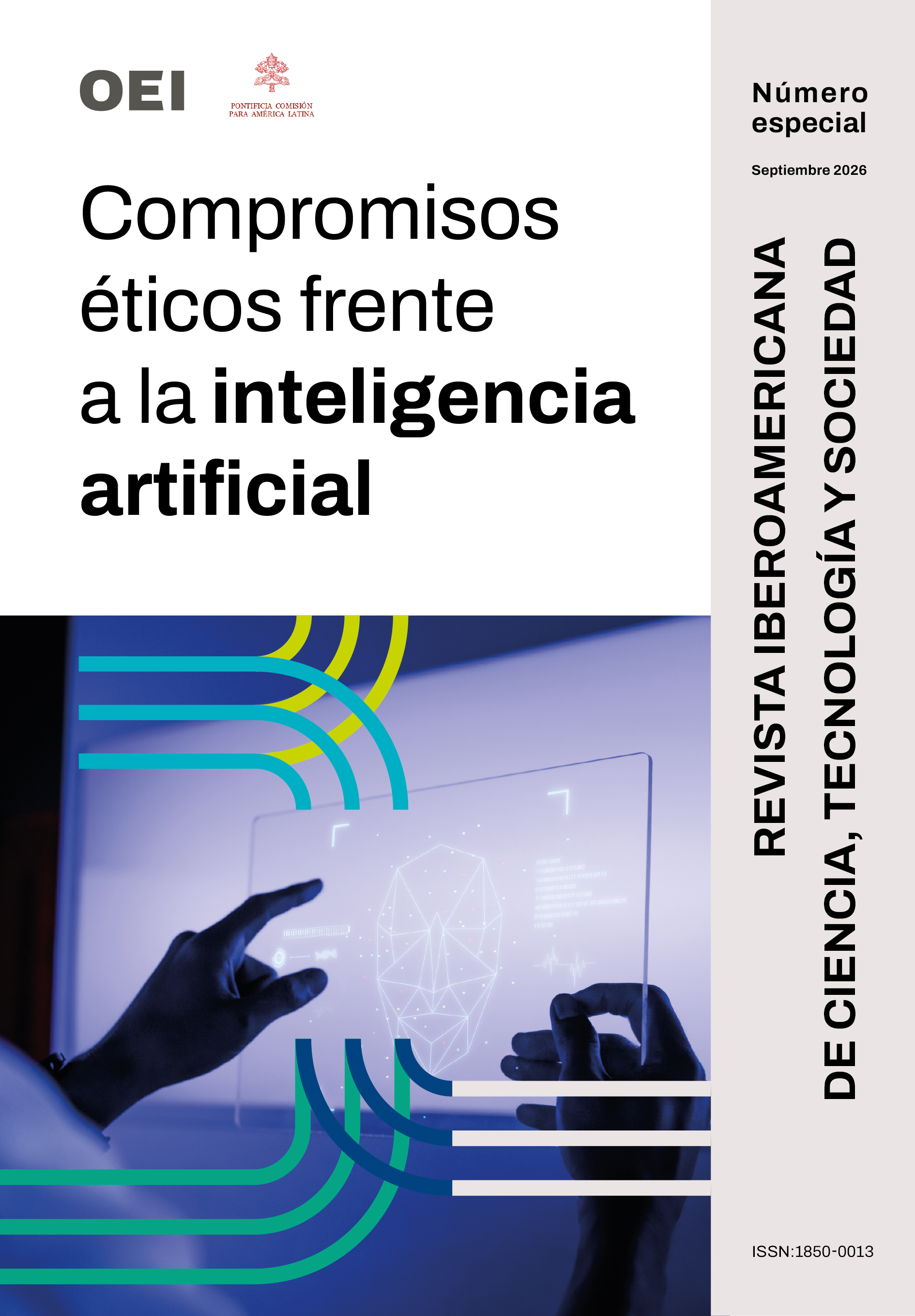
O desenvolvimento acelerado da inteligência artificial (IA) constitui um dos fenômenos mais significativos e disruptivos do século XXI, tanto por sua capacidade de transformar as estruturas que mantêm a sociedade contemporânea quanto pelas considerações éticas que suscita sua aplicação. Em um contexto global no qual múltiplas crises sociais, políticas, econômicas e ambientais convergem simultaneamente, a IA se apresenta como promessa e ameaça à vida tal como a conhecemos. Seu impacto não se limita à esfera técnica, mas também afeta as dinâmicas de poder, a organização e a produtividade do trabalho, a educação e a socialização, a produção acadêmica e a formulação de políticas públicas. Diante das preocupações e dos questionamentos que esses avanços tecnológicos colocam, a reflexão ética emerge como condição indispensável para que essa tecnologia esteja a serviço do ser humano e não se converta em instrumento de exclusão ou dominação. Este artigo propõe uma abordagem interdisciplinar a partir das ciências sociais, incorporando uma reflexão meta-acadêmica: o uso da IA como ferramenta para analisar a si mesma de modo a contribuir para os desafios contemporâneos.
Downloads
Referências
Archibugi, D. (2022). Technological sovereignty: Democracy, power and the governance of technology. Cambridge University Press.
Arun, C. (2020). AI and the Global South: Designing for other worlds. En M. Dubber, F. Pasquale & S. Das (Eds.), The Oxford Handbook of Ethics of AI (207–222). Oxford: Oxford University Press.
Bauman, Z. (2000). Liquid modernity. Cambridge: Polity Press.
Bauman, Z. & Bordoni, C. (2016). State of crisis. Cambridge: Polity Press.
Bender, E. M., Gebru, T., McMillan-Major, A. & Shmitchell, S. (2021). On the dangers of stochastic parrots: Can language models be too big? Proceedings of the 2021 ACM Conference on Fairness, Accountability, and Transparency, 610-623. Recuperado de: https://s10251.pcdn.co/pdf/2021-bender-parrots.pdf.
Benjamin, R. (2019). Race after technology: Abolitionist tools for the new Jim code. Cambridge: Polity Press.
Birhane, A. (2021). Algorithmic injustice: A relational ethics approach. Patterns, 2(2), 100205.
Carroll, J. B. (1993). Human cognitive abilities: A survey of factor-analytic studies. Cambridge: Cambridge University Press.
Castells, M. (2020). The information age: Economy, society, and culture (Vol. 1: The rise of the network society, 3rd ed.). Hoboken: Wiley-Blackwell.
Cattell, R. B. (1941). Some theoretical issues in adult intelligence testing. British Journal of Educational Psychology Monograph Supplement.
Ciucci, A. (2023). Human dignity in the age of artificial intelligence. Pontifical Academy for Life. Comisión Europea (2021). Proposal for a regulation laying down harmonised rules on artificial intelligence (Artificial Intelligence Act). Recuperado de: https://eur-lex.europa.eu/legal-content/EN/TXT/?uri=celex%3A52021PC0206.
Couldry, N. & Mejías, U. A. (2019). The costs of connection: How data is colonizing human life and appropriating it for capitalism. Stanford: Stanford University Press.
Crary, J. (2013). 24/7: Late capitalism and the ends of sleep. Nueva York: Verso Books.
Crawford, K. (2021). Atlas of AI: Power, politics, and the planetary costs of artificial intelligence. New Haven: Yale University Press.
Crawford, K. & Paglen, T. (2019). Excavating AI: The politics of images in machine learning training sets. Recuperado de: https://excavating.ai/.
Cristianini, N. (2023). The shortcut: Why intelligent machines do not think like us. Boca Ratón: CRC Press.
Daly, H. E. (1996). Beyond growth: The economics of sustainable development. Boston: Beacon Press.
Dennett, D. C. (1987). The intentional stance. Cambridge: MIT Press.
Donovan, J. (2022). Meme wars: The untold story of the online battles upending democracy in America. Londres: Bloomsbury.
Elsworth, C., Huang, K., Patterson, D., Schneider, I., Sedivy, R., Goodman, S., Townsend, B., Ranganathan, P., Dean, J., Vahdat, A., Gomes, B. & Manyika, J. (2025). Measuring the environmental impact of delivering AI at Google scale.
Eubanks, V. (2018). Automating inequality: How high-tech tools profile, police, and punish the poor. Nueva York: St. Martin’s Press.
Floridi, L. (2013). The ethics of information. Oxford: Oxford University Press.
Floridi, L. & Cowls, J. (2019).Aunified framework of five principles forAI in society. Harvard Data Science Review, 1(1), 1-15. DOI: https://www.doi.org/10.1162/99608f92.8cd550d1.
Francisco (2015). Laudato si’: Sobre el cuidado de la casa común. Ciudad del Vaticano: Libreria Editrice Vaticana. Recuperado de: https://www.vatican.va/content/francesco/es/encyclicals/documents/papa-francesco_20150524_enciclica-laudato-si.html.
Francisco (2020). Fratelli tutti: Sobre la fraternidad y la amistad social. Ciudad del Vaticano: Libreria Editrice Vaticana. Recuperado de: https://www.vatican.va/content/francesco/es/encyclicals/documents/papa-francesco_20201003_enciclica-fratelli-tutti.pdf.
Gandy, O. H. (2021). The panoptic sort revisited: Data, discrimination, and new technologies of control. Oxford: Oxford University Press.
Gardner, H. (1983). Frames of mind: The theory of multiple intelligences. Nueva York: Basic Books.
Gebru, T. et al. (2018). Algorithmic impact assessments: A practical framework for public agency accountability. Data & Society Research Institute.
Han, B.-C. (2021). The disappearance of rituals: A topology of the present. Cambridge: Polity Press.
Harari, Y. N. (2018). 21 lessons for the 21st century. Nueva York: Spiegel & Grau.
Helbing, D. (2022). Towards digital enlightenment: Essays on the dark and light sides of the digital revolution. Heidelberg: Springer.
Horn, J. L. (1968). Organization of abilities and the development of intelligence. Psychological Review, 75(3), 242-259. Recuperado de: https://www.researchgate.net/publication/18292505_ORGANIZATION_OF_ABILITIES_AND_THE_DEVELOPMENT_OF_INTELLIGENCE.
Hutter, M. (2005). Universal artificial intelligence: Sequential decisions based on algorithmic probability. Heidelberg: Springer.
Ihde, D. (1990). Technology and the lifeworld: From garden to earth. Bloomington: Indiana University Press.
Innerarity, D. (2020). Politics in the times of indignation: Populism and democracy. Londres: Bloomsbury Academic.
Latour, B. (1987). Science in action: How to follow scientists and engineers through society. Cambridge: Harvard University Press.
Legg, S. & Hutter, M. (2007). Universal intelligence: A definition of machine intelligence. Minds and Machines, 17(4), 391-444.
Leonelli, S. (2021). Data-centric biology: A philosophical study. Chicago: University of Chicago Press.
Levy, P. (2020). Collective intelligence for the common good. Nueva York: Routledge.
Metzinger, T. (2021). Artificial suffering: An argument for a global moratorium on synthetic phenomenology. Journal of Artificial Intelligence and Consciousness, 8(1), 1-44.
Morin, E. (2020). Changeons de voie: Les leçons du coronavirus. París: Denoël. Morozov, E. (2020). Freedom as a service: Surveillance capitalism and the Internet of things. Nueva York: PublicAffairs.
Naciones Unidas (2015). Transformar nuestro mundo: la Agenda 2030 para el desarrollo sostenible. Recuperado de: https://unctad.org/system/files/official-document/ares70d1_es.pdf.
Naciones Unidas (2021). Our common agenda. Recuperado de: https://www.un.org/en/content/common-agenda-.
Noble, S. U. (2018). Algorithms of oppression: How search engines reinforce racism. Nueva York: NYU Press.
Noë, A. (2004). Action in perception. Cambridge: MIT Press.
O’Neil, C. (2016). Weapons of math destruction: How big data increases inequality and threatens democracy. Nueva York: Crown Publishing.
OCDE (2024). AI in the public sector: Opportunities and challenges. Recuperado de: https://www.oecd.org/content/dam/oecd/en/publications/reports/2024/06/governing-with-artificial-intelligence_f0e316f5/26324bc2-en.pdf.
OIT (2023). Generative AI and jobs: Policy implications. International Labour Office. ILO Working Paper 96. Recuperado de: https://www.ilo.org/sites/default/files/wcmsp5/groups/public/%40dgreports/%40inst/documents/publication/wcms_890761.pdf.
Pasquinelli, M. & Joler, V. (2020). The nooscope manifested: AI as instrument of knowledge extractivism. KIM HfG Karlsruhe.
Patterson, D., Gonzalez, J., Le, Q., Liang, C., Munguia, L.-M., Rothchild, D., So, D., Texier, M. & Dean, J. (2021), Carbon emissions and large neural network training. Recuperado de: https://arxiv.org/pdf/2104.10350.
Piaget, J. (1952). The origins of intelligence in children. Madison: International Universities Press.
Ricaurte, P. (2021). Data epistemologies, the coloniality of power, and resistance. Television & New Media, 22(2), 131-146.
Riorda, M. (2021). Comunicación política en tiempos de pandemia: La democracia gaseosa. Buenos Aires: Editorial Biblos.
Rosa, H. (2013). Social acceleration: A new theory of modernity. Nueva York: Columbia University Press.
Rouvroy, A. (2020). The end(s) of critique: Data-behavioural science and the society of (unknown) control. En M. Hildebrandt & K. O’Hara (Eds.), Life and the law in the era of data-driven agency (67-92). Cheltenham: Edward Elgar.
Russell, S. J. & Norvig, P. (1995). Artificial intelligence: A modern approach. Upper Saddle River: Prentice Hall.
Russell, S. J. & Norvig, P. (2020). Artificial intelligence: A modern approach. Londres: Pearson.
Searle, J. R. (1980). Minds, brains, and programs. Behavioral and Brain Sciences, 3(3), 417-457.
Selbst, A. D., Boyd, D., Friedler, S. A., Venkatasubramanian, S. & Vertesi, J. (2019). Fairness and abstraction in sociotechnical systems. En Proceedings of the Conference on Fairness, Accountability, and Transparency (59–68). Nueva York: Association for Computing Machinery.
Shannon, C. E. (1948a). A mathematical theory of communication. Bell System Technical Journal, 27(3), 379-423.
Shannon, C. E. (1948b). A mathematical theory of communication. Bell System Technical Journal, 27(4), 623-656.
Simon, H. A. (1969). The sciences of the artificial. Cambridge: MIT Press.
Simondon, G. (2017). On the mode of existence of technical objects. Minneapolis: University of Minnesota Press.
Spearman, C. (1904). “General intelligence,” objectively determined and measured. The American Journal of Psychology, 15(2), 201-293.
Srnicek, N. (2016). Platform capitalism. Cambridge: Polity Press.
Sternberg, R. J. (1985). Beyond IQ: A triarchic theory of human intelligence. Cambridge: Cambridge University Press.
Sternberg, R. J. (1988). The triarchic mind: A new theory of human intelligence. Nueva York: Viking.
Striphas, T. (2022). Algorithmic culture: Between computation and cultural theory. Cultural Studies, 36(2), 211-232.
Strubell, E., Ganesh, A. & McCallum, A. (2019). Energy and policy considerations for deep learning in NLP. Recuperado de: https://arxiv.org/pdf/1906.02243.
Tooze, A. (2021). Shutdown: How Covid Shook the World’s Economy. Nueva York: Viking.
Topol, E. (2019). Deep medicine: How artificial intelligence can make healthcare human again. Nueva York: Basic Books.
Turing, A. M. (1950). Computing machinery and intelligence. Mind, 59(236), 433-460.
UNESCO (2021). Recommendation on the ethics of artificial intelligence. Recuperado de: https://www.naavi.org/uploads_wp/2023/Recommendation%20on%20the%20Ethics%20of%20Artificial%20Intelligence%20-%20UNESCO%20Digital%20Library.pdf.
Vaidhyanathan, S. (2018). Antisocial media: How Facebook disconnects us and undermines democracy. Oxford: Oxford University Press.
van Dijck, J., Poell, T. & de Waal, M. (2018). The platform society: Public values in a connective world. Oxford: Oxford University Press.
van Dijck, J. (2021). Governing digital societies: Private platforms, public values. Communication and the Public, 6(1-2), 14-19.
Varela, F. J., Thompson, E. & Rosch, E. (1991). The embodied mind: Cognitive science and human experience. Cambridge: MIT Press.
Verbeek, P.-P. (2011). Moralizing technology: Understanding and designing the morality of things. Chicago: University of Chicago Press.
Virilio, P. (1977). Vitesse et politique: Essai de dromologie. París: Galilée. Virilio, P. (2006). Speed and politics. Marsella: Semiotext(e).
Vygotsky, L. S. (1978). Mind in society: The development of higher psychological processes. Cambridge: Harvard University Press.
Wiener, N. (1948). Cybernetics: Or control and communication in the animal and the machine. Cambridge: MIT Press.
Wu, T. (2016). The attention merchants: The epic scramble to get inside our heads. Nueva York: Knopf.
Zuboff, S. (2019). The age of surveillance capitalism: The fight for a human future at the new frontier of power. Nueva York: PublicAffairs.
Downloads
Publicado
Como Citar
Edição
Seção
Licença
Copyright (c) 2025 CC Attribution 4.0

Este trabalho está licenciado sob uma licença Creative Commons Attribution 4.0 International License.
Todas os números de CTS e seus artigos individuais estão sob uma licença CC-BY.
Desde 2007, a CTS proporciona acesso livre, aberto e gratuito a todos seus conteúdos, incluídos o arquivo completo da edição quadrimestral e os diversos produtos apresentados na plataforma eletrônica. Esta decisão é baseada no entendimento de que fornecer acesso livre aos materiais publicados ajuda a ter uma maior e melhor troca de conhecimentos.
Por sua vez, em se tratando da edição quadrimestral, a revista permite aos repositórios institucionais e temáticos, bem como aos sites pessoais, o autoarquivo dos artigos na versão post-print ou versão editorial, logo após da publicação da versão definitiva de cada número e sob a condição de incorporar ao autoarquivo um link direcionado à fonte original.